
Rocky River City Directory Holdings
Cleveland Public Library, or CPL, provides the main Rocky River directory trail. Its suburban collection includes a standalone Rocky River Directory for 1954-55, Lakewood volumes that include Rocky River for selected editions from 1949 through 1963, and West Suburban books from 1964 through 1980. The library's Digital Gallery adds a small online shelf. The Rocky River Historical Society, or RRHS, preserves a separate 1975 residents directory within a broader local archive. Each source is useful for a different date, so record the exact edition rather than treating these as one continuous roll.
| Collection | Years | Where Held | Access |
|---|---|---|---|
| Rocky River Directory, Orange Line Publishing | 1954-55 | CPL directory collection | Collection access |
| Lakewood City Directory | 1949, 1951, 1953, 1954-55, 1956-63 | CPL suburban microfilm | Microfilm |
| West Suburban directory | 1964-80 | CPL History Department | Complete microfilm run |
| Digitized Cleveland and West Suburban volumes | 1929, 1930, 1938, 1970 | CPL Digital Gallery | Online selected editions |
| RRHS Residents Directory | 1975 | Rocky River Historical Society | Contact before visiting |
Directory timeline. The collections change titles and access formats over time, which is why the year belongs in every research note.
- 1924-25: CPL's suburban microfilm series begins its 1924-63 span, and Cleveland directory title pages begin listing included suburbs, including Rocky River according to CPL's guide.
- 1949: the Lakewood series begins the selected Rocky River coverage listed by CPL.
- 1954-55: Orange Line Publishing issues the standalone Rocky River Directory.
- 1964: city and suburban books merge into East and West Suburban runs.
- 1970: the West Suburban edition that includes Rocky River is available in CPL's Digital Gallery.
- 1975: the RRHS institutional collection lists a residents directory.
- 1980: CPL's West Suburban microfilm run ends.
The dates are coverage guides, not a promise that every title-page list stayed the same. CPL's property-research guide says Cleveland directory title pages began listing included suburbs in 1925, but the list contracted in 1951. Check the title page of the actual book before spending time on a surname or street search.
Rocky River Directory Runs at CPL
The Lakewood series gives Rocky River researchers a dense run of postwar editions. The 1949, 1951, 1953, 1954-55, and annual 1956-63 books include Rocky River alongside other west-side communities. Westlake joins that series in 1958 and North Olmsted in 1962, details that help explain a volume's wider geographic scope. In 1964, the city and suburban books were merged into East and West Suburban runs. For a house history, that change means the same address may move to a differently titled book even though the city has not changed.
The Cleveland Public Library Digital Gallery is the online starting point for selected scans, while the broader suburban range remains a microfilm task. CPL's guide describes 83 suburban microfilm volumes spanning 1924-63 and says those suburban volumes are not held in paper. That is a useful access boundary: use the gallery first for an available edition, then plan for library microfilm or ask staff about the correct volume.
CPL also reports its Cleveland directory run as complete on microfilm but extensive and incomplete in paper. Scans and photocopies from microfilm are permitted, while printed volumes are not photocopied to avoid damage. That split makes the microfilm reader a normal part of a full local search, rather than a last resort after an online search.
CPL's digitized directory collection shows the online catalog used for Rocky River historical research.
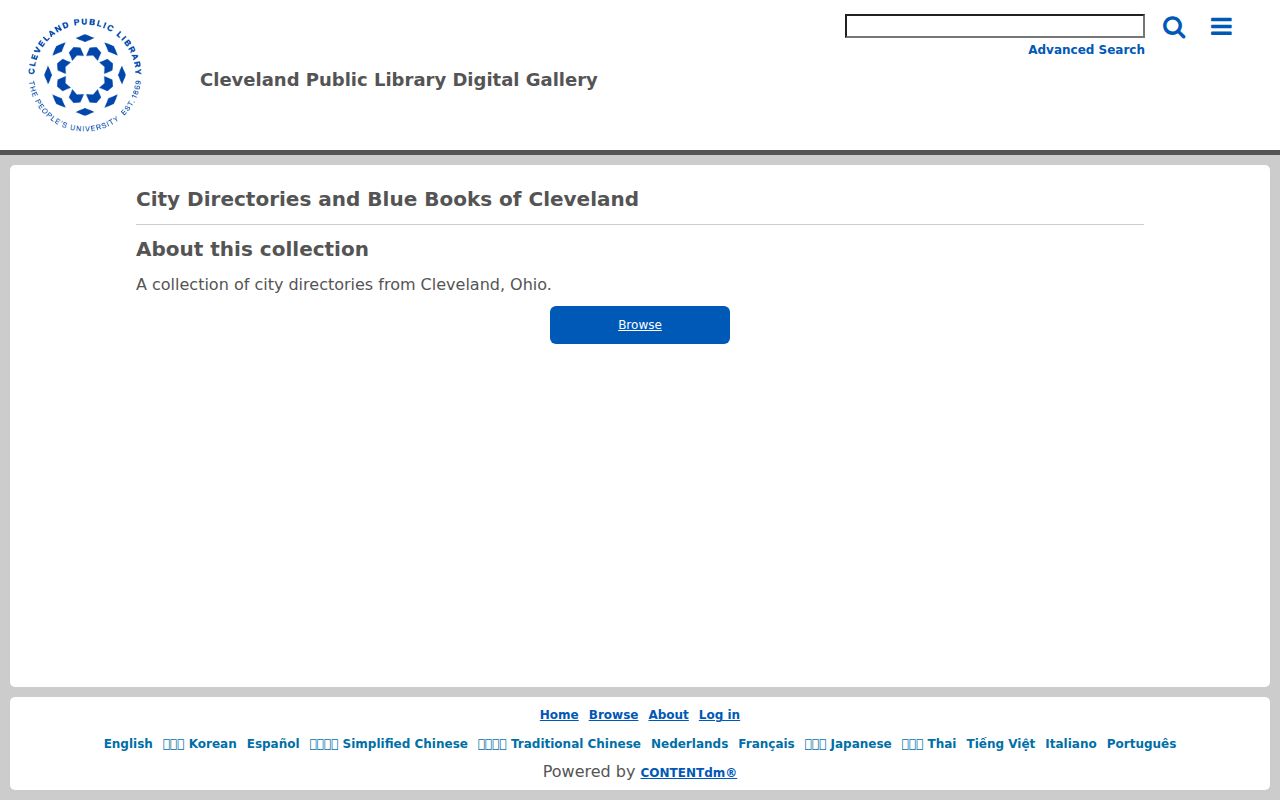
The gallery is a selected digital shelf, so a missing search result should lead back to the relevant microfilm run rather than ending the search.
Rocky River Digitized Directory Pages
CPL's digitized 1929, 1930, and 1938 Cleveland directories expressly include Rocky River in their record descriptions. These editions are valuable because the library guide says property lists arranged with the address at the end begin in 1929. A 1930 street-guide page also shows why a surname search is only one route: it can give street heading and direction, block spans or intersections, numbered dwellings, occupants, apartments, vacancies, and even a note that there were no houses.
Use the collection's search option when a digitized record exposes one, but inspect the page image too. OCR can miss names, initials, punctuation, or faint type. A page number and the volume year make a much better research note than a bare name copied from an on-screen search box.
The 1929 CPL directory record is one of the digitized Rocky River sources.
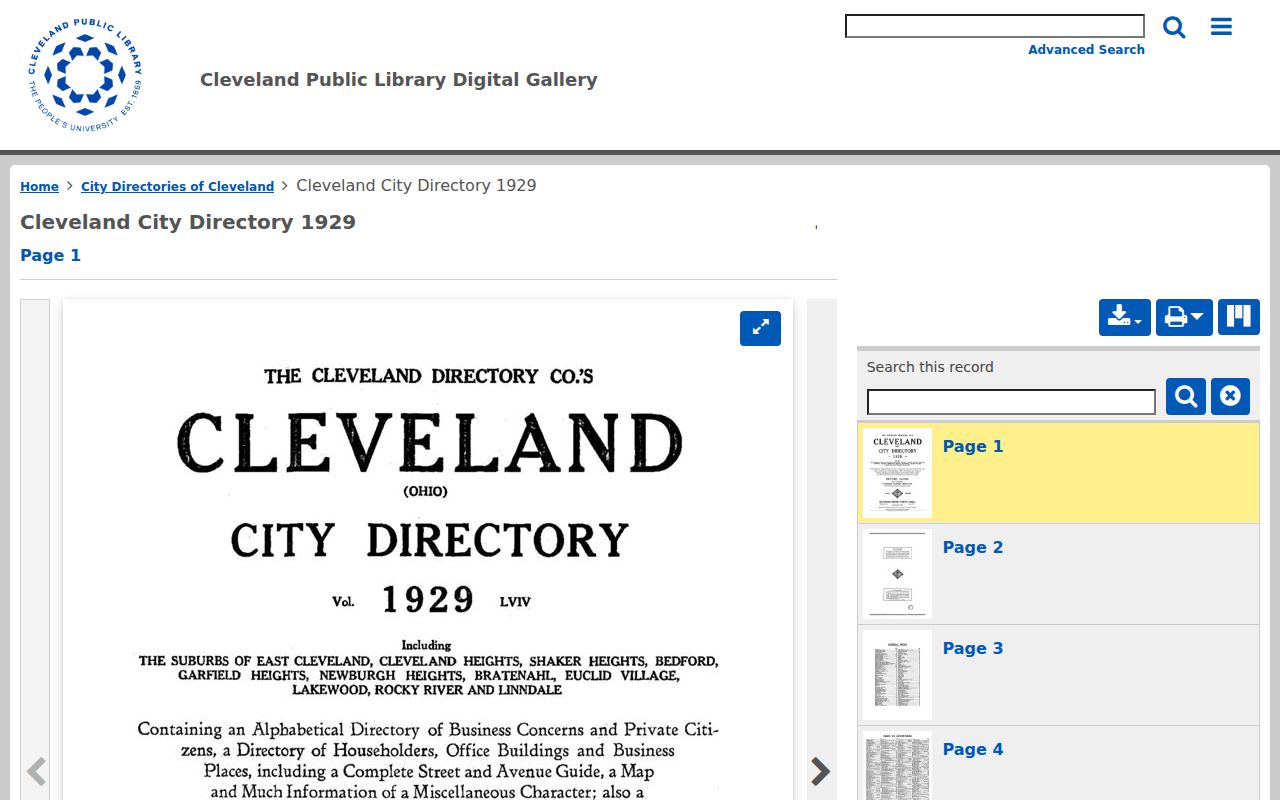
That early digitized record helps place a Rocky River household in a dated edition, but it does not establish a present connection to the address.
Reading a Rocky River Directory Line
A directory line is compact, and its abbreviations matter. CPL's inspected 1951 page uses surname-first ordering, a spouse in parentheses where supplied, a listing detail, a residence marker, street address, and the municipality code. The 1970 West Suburban explanatory material defines RR as Rocky River. It also explains that wives' names follow a husband in parentheses, a widow may appear as (wid [husband]), h marks head of house, and r marks another family member or roomer.
| Name | Surname first, followed by given name and a spouse or widow notation where supplied. |
|---|---|
| Listing detail | An occupation and employer may appear after the name. |
| Household mark | h means head of house; r identifies another family member or roomer in the 1970 key. |
| Address | The street address ties the line to a place in that edition. |
| Municipality | RR identifies Rocky River in the West Suburban key. |
- Criss-cross directory
- The address-ordered portion of a directory, used to begin with a street and locate listed names for that edition.
- Householder index
- A name or address arrangement that identifies the household associated with a listed dwelling in the book.
- Abbreviation key
- The explanatory page that defines the marks used in one volume. Photograph or note it before interpreting individual lines.
Rocky River Directory in 1970
The digitized 1970 West Suburban Directory is especially broad. Its record describes a book that includes Rocky River among 20 western municipalities and combines alphabetical residents, a classified business directory, a buyer guide, a street-address directory, and telephone numbers. That mix makes it useful for moving from a surname to an address order, but each part still reflects the date and conventions of that one book.
CPL's 1970 West Suburban Directory record identifies the edition and its components.
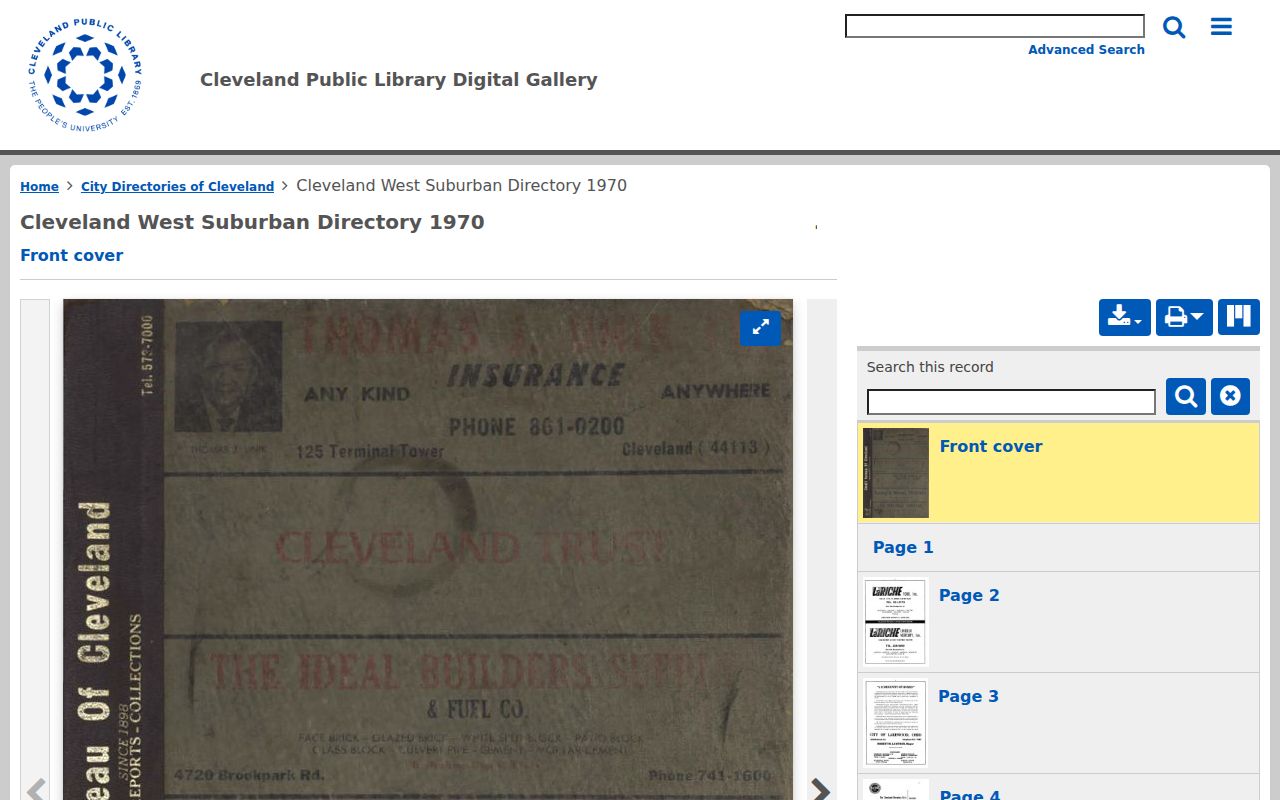
The street-address component is a historical research aid, not a substitute for the modern parcel and deed workflow on the Rocky River Street Directory page.
Trace Rocky River City Directory Households
Start with the clearest dated appearance, then build outward rather than forcing a match. The city directory sequence can bridge years between federal censuses, while the census supplies a separate household check. A move, a new spouse notation, or a changed surname is a prompt to test another record, not a reason to combine two similar names.
- Find the surname in a verified Rocky River edition and note the volume year, page, address, and all printed marks.
- Check the next available edition forward and backward for the same address, spouse notation, or other stable detail.
- Use the criss-cross or street-address portion when the question begins with a house instead of a name.
- Pair the directory sequence with the appropriate census year and keep conflicting details visible in the notes.
- Use an obituary, Probate record, or recorded document only through its own custodian when the family trail needs another identifier.
If a person disappears, the book alone cannot say why. A move, death, an unlisted household member, a changed name, or a publishing omission can produce the same result. For a current, one-person confirmation, shift to the Rocky River Resident Lookup workflow rather than treating an old line as current proof.
Rocky River Directory Research at RRPL
Rocky River Public Library extends a directory search with local-history tools and staff help. Its genealogy guide lists CLEVNET access, in-library-only Ancestry Library Edition, HeritageQuest, and Ohio Sanborn maps. Ancestry Library Edition includes directories, census images, court, land, and Probate material, but it is available in the library rather than as a general remote resource. HeritageQuest adds census images and family or local-history material.
RRPL also has Cleveland Plain Dealer microfilm from April 1875 forward and Cleveland Press microfilm from January 1975 through July 1981. The library is at 1600 Hampton Road, Rocky River, and its published phone is 440-333-7610. One-on-one genealogy appointments are available through Adult Services at extension 5501. Verify current opening hours before going, since the research source's listed schedule may change.
Its Sanborn resource includes more than 40,000 detailed Ohio city maps dated 1882-1962. A map can help interpret a changed street form or the shape of a block, while the directory supplies the dated name and address line. Keep those source roles separate when recording a house or family history.
RRPL's genealogy guide describes the databases, maps, microfilm, and appointment channel behind this local research path.
Rocky River Directory at the Historical Society
RRHS adds a distinctly local 1975 residents directory to its institutional holdings. Its finding aid also describes house, family, civic, oral-history, Reuben Wood, map, drawing, photo, and correspondence material. That makes the Society a strong next contact after a directory page raises a question about a place or family. It is not a complete public list, and the site does not publish a full item-level catalog for its collections.
The Society was founded in 1968 and asks researchers to contact it before visiting. Its published contact details are Rocky River Historical Society Collections, 440-331-4614, and rnhistorical@gmail.com; its address is 1101 Morewood Parkway / PO Box 16445, Rocky River, OH 44116.
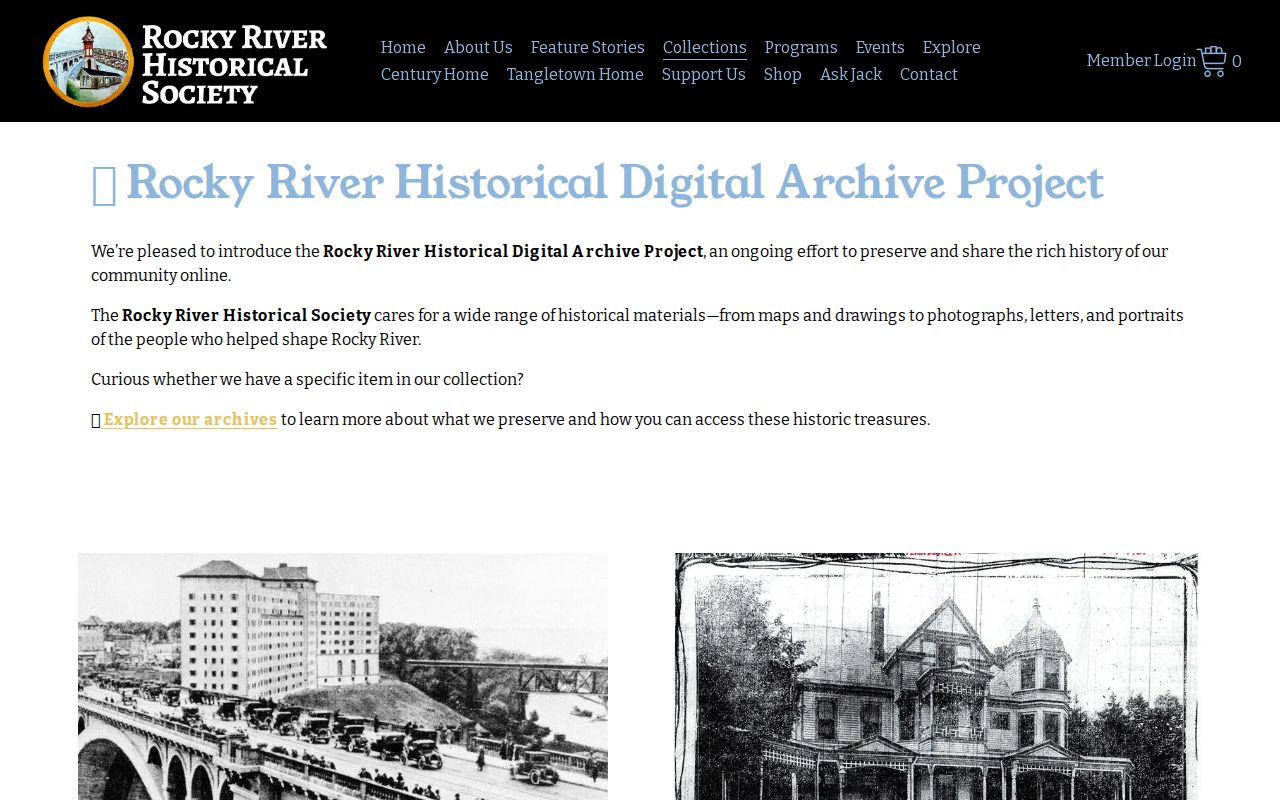
The 1975 directory is a useful local snapshot within a selective archive, so request the exact item and record its date when the Society can provide access.
Rocky River Directory Place Names
Historic place names can explain a failed address search. Research guides identify Wagar with Columbus or Columbia, Detroit with North Ridge, Blount as later part of Lake Road, and Wooster as first Mastick. Rocky River's civic history also shifts the place label around an older record: an 1891 hamlet, a 1903 village, and a 1930 city are described by the Encyclopedia of Cleveland History. The City Community Profile gives 1893 for the hamlet, so preserve the source behind either date instead of flattening that difference.
Use old and later street forms as search variants in a city directory, map, or archive request. They are geographic clues, not proof that two named people are the same person.